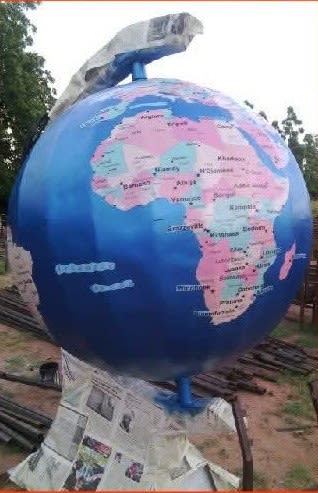
Eclipses Model
Danyaya Eclipses Demonstration Mode
The Danyaya Eclipses Demonstration Model is a large educational model of the Sun, Earth, and Moon designed to show how solar and lunar eclipses occur. By demonstrating their movement, alignment, and shadow formation, the model helps students understand full and partial eclipses through clear physical observation.

Objectives
The objective of the Danyaya Eclipses Demonstration Model is to provide a clear, practical, and visual explanation of how solar and lunar eclipses occur. It is designed to help students understand the positions, rotation, revolution, and alignment of the Sun, Earth, and Moon, as well as how these movements produce full and partial eclipses. The model also aims to simplify the teaching of astronomy by transforming an abstract scientific concept into a large, observable demonstration that supports classroom learning, science exhibitions, and public education.
Problem Being Addressed
Many students find eclipses difficult to understand because they are often taught through flat diagrams, textbook descriptions, or brief videos that do not fully show the movement and alignment of the Sun, Earth, and Moon. The Danyaya Eclipses Demonstration Model addresses this challenge by providing a large, practical, and visible representation of the three celestial bodies. It allows learners to observe how their rotation, revolution, positions, and shadows produce full and partial solar and lunar eclipses. The model therefore helps to reduce abstract learning, correct common misconceptions, and make astronomy lessons clearer, more engaging, and easier to remember.
Inspiration
The inspiration for the Danyaya Eclipses Demonstration Model came from the need to make the occurrence of solar and lunar eclipses easier for students to understand. Danyaya observed that many learners struggle to imagine the movement and alignment of the Sun, Earth, and Moon when the concept is explained only through textbooks and flat diagrams. He was therefore inspired to create a large physical model that could reproduce these movements in a clear and practical way. The invention reflects his belief that complex scientific ideas become easier to understand when learners can observe them directly, follow the movement of the objects involved, and see how light and shadow produce different forms of eclipses.
Materials and Technologies Used
The Danyaya Eclipses Demonstration Model was constructed using a combination of metal framing, moulded spherical structures, support systems, mechanical components, electrical fittings, and lighting technology. The Sun, Earth, and Moon are represented by large spherical models designed to show their relative positions and movements in space. Strong metal supports and suspended mounting systems hold the celestial bodies in place while allowing them to rotate and revolve as required. Mechanical parts, including shafts, bearings, gears, motors, and connecting arms, control the movement of the Earth around the Sun and the Moon around the Earth. A powerful light source is used to represent the Sun and produce visible shadows. This enables the model to demonstrate how the Moon’s shadow falls on the Earth during a solar eclipse and how the Earth’s shadow falls on the Moon during a lunar eclipse. By adjusting the positions and alignment of the models, both full and partial eclipses can be displayed. The surfaces of the Earth and Moon are shaped, painted, and marked to resemble their physical appearance, while electrical controls help regulate movement, speed, direction, and lighting. The model may also include switches, control panels, labels, and explanatory displays to support demonstrations and guided lessons. Through the integration of physical modelling, mechanical motion, electrical systems, and controlled lighting, the invention provides a clear and practical representation of the movements and alignments that cause solar and lunar eclipses.
Educational and Social Value
The Danyaya Eclipses Demonstration Model has strong educational value because it enables students to understand eclipses through direct observation rather than abstract explanation alone. It helps learners see the relationship among the Sun, Earth, and Moon and understand how their movements, positions, and alignment produce full and partial solar and lunar eclipses. The model supports the teaching of astronomy, geography, basic science, and space studies. Its large size makes it suitable for group demonstrations, school excursions, science exhibitions, museums, and public learning centres, where many learners can observe the process at the same time. Socially, the invention promotes interest in science, technology, engineering, and innovation. It can stimulate curiosity among young people, encourage practical learning, and inspire students to explore astronomy and related scientific fields. The model also makes scientific knowledge more accessible to schools and communities that may not have advanced laboratories or specialised teaching equipment. By simplifying a complex natural phenomenon, it contributes to science awareness, public education, and the development of a stronger culture of practical and experiential learning.