Large-Scale Globe
Danyaya Large-Scale Rotating Metal Globe Model
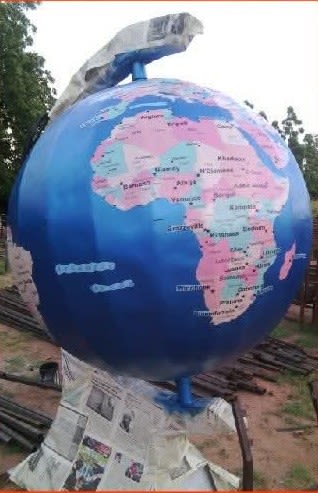
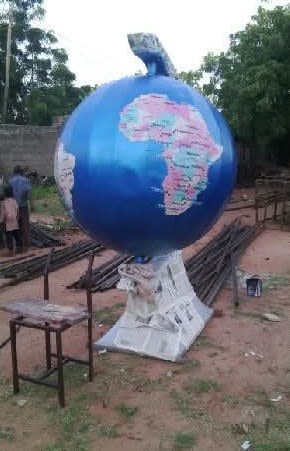
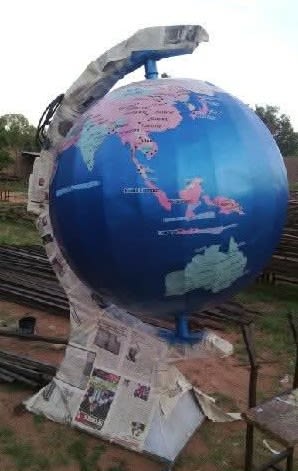
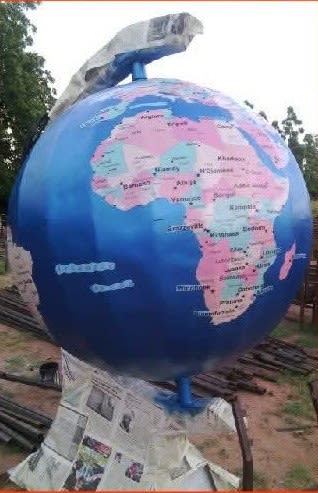
The Danyaya Rotating Metal Globe Model is a large-scale educational globe constructed primarily from metal and designed to rotate on its axis. It displays the continents, countries, oceans, and major geographical locations, while external lighting improves visibility and presentation during demonstrations, exhibitions, and public displays.
Objectives
The objective of the Danyaya Rotating Metal Globe Model is to provide a large, clear, and practical representation of the Earth for educational and public learning purposes. It is designed to help students and visitors identify continents, countries, oceans, and major geographical locations more easily. The model also aims to demonstrate the Earth’s rotation through its movement on an axis, making an otherwise abstract geographical concept visible and understandable. Its external lighting further supports clear observation during exhibitions, demonstrations, and evening displays. More broadly, the invention seeks to promote interest in geography, astronomy, science, metal fabrication, and practical innovation through an engaging physical learning experience.
Problem Being Addressed
Many students encounter geography mainly through small classroom globes, flat maps, or textbook illustrations, which may not clearly communicate the Earth’s spherical shape, scale, and continuous rotation. Small teaching aids can also be difficult for large groups to observe during lessons and public demonstrations. The Danyaya Rotating Metal Globe Model addresses this challenge by providing a large, durable, and visible representation of the Earth. Its size allows many learners to study the continents, countries, oceans, and geographical locations at the same time, while its rotation on an axis demonstrates the movement of the Earth in a practical and understandable way. The model also responds to the limited availability of locally constructed, large-scale educational installations suitable for schools, exhibitions, museums, and public learning spaces. Its metal structure provides durability, while the external lighting improves visibility and makes the globe suitable for both daytime and evening displays.
Inspiration
The inspiration for the Danyaya Rotating Metal Globe Model came from the desire to make the study of the Earth more practical, visible, and engaging. Danyaya recognised that many learners encounter the world mainly through flat maps, small globes, and textbook illustrations that may not fully capture the Earth’s spherical form or rotational movement. He was therefore inspired to construct a much larger and more durable model that students and members of the public could observe clearly from different angles. The rotating mechanism was introduced to demonstrate the movement of the Earth on its axis, while the external lighting was added to improve visibility and presentation. The invention also reflects his background in technical craftsmanship, metal fabrication, education, and practical innovation. It demonstrates his belief that familiar scientific and geographical concepts can be transformed into impressive physical models that stimulate curiosity and make learning easier to understand and remember.
Materials and Technologies Used
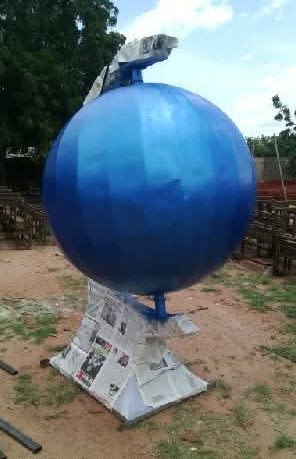
The Danyaya Rotating Metal Globe Model was constructed primarily from metal, using welded steel components to form the spherical framework, supporting axis, stand, and base. The metal structure provides the strength and durability required to support the globe’s large size and continuous rotational movement. The outer surface was shaped and covered with suitable panels or finishing materials before being painted and labelled to represent the continents, countries, oceans, and major geographical locations. Geographic outlines, names, colours, and other details were carefully applied to make the model clear and educational. A mechanical rotation system allows the globe to turn smoothly on its axis. This system may include a central shaft, bearings, gears, an electric motor, electrical wiring, switches, and control components. The supporting frame keeps the globe stable while permitting controlled rotation. External lighting equipment is positioned around the model to illuminate its surface. The lights improve the visibility of the geographical details and enhance the globe’s appearance during exhibitions, demonstrations, public events, and evening displays. The invention therefore combines metal fabrication, welding, mechanical engineering, electrical installation, geographical mapping, painting, and structural design to create a durable and functional educational model.
Educational and Social Value
The Danyaya Rotating Metal Globe Model has significant educational value because it helps students understand the Earth as a spherical and rotating body. Its large size allows learners to identify continents, countries, oceans, and major geographical locations more clearly than they might with small classroom globes or flat maps. The model supports the teaching of geography, basic science, astronomy, environmental studies, and social studies. By rotating on its axis, it provides a practical demonstration of the Earth’s movement and helps learners connect classroom explanations with a visible physical model. Socially, the globe serves as an attractive public learning installation that can be used in schools, exhibitions, museums, science centres, tourist sites, and community events. It encourages curiosity, discussion, and shared learning among children, students, families, and members of the public. The invention also demonstrates the value of local creativity, technical craftsmanship, and metal fabrication. It can inspire young people to develop interest in science, engineering, geography, design, and practical innovation while showing that educational equipment can be designed and constructed locally.
Collaborators: Following the successful construction of the first rotating metal globe, some universities, including Gombe State University, the University of Ilorin, and other institutions, requested similar models. The globes were subsequently constructed and delivered to the requesting universities for educational and public display purposes.
Gallery